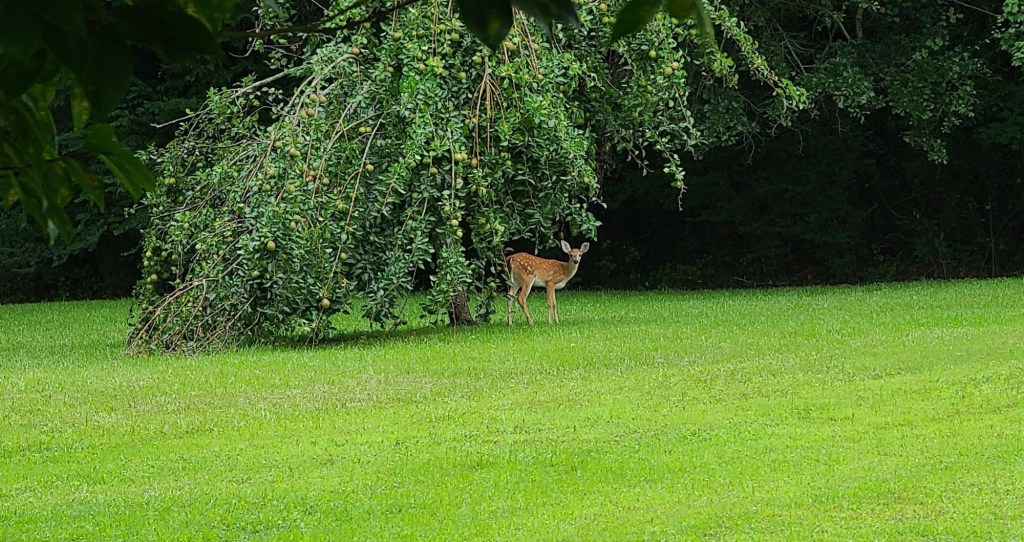
“As the deer pants for streams of water, so my soul pants for you, O God. My soul thirsts for God, for the living God…” (Psalm 42:1)

Consider the lilies of the field… Matt 6:28
“As the deer pants for streams of water, so my soul pants for you, O God. My soul thirsts for God, for the living God…” (Psalm 42:1)
 thedailylily.com
https://www.youtube.com/watch?v=78lj3sl8L9M
What a beautiful photo! It helps me understand the words of the Psalm that Sara posted as well as the song. That deer is totally dependent on what God provides for it…food (like the tree with fruit pictured), shelter and water.
We are dependent on Him too. For every breath, every step we take, and all provisions. It reminds me of this scripture, “The eyes of all look to you in hope; you give them their food as they need it. When you open your hand, you satisfy the hunger and thirst of every living thing. The Lord is righteous in everything he does; he is filled with kindness.” Psalm 145:15-17
And these words from the song express this I think and helps me know that therefore, it is to Him alone that I should bow and yield my will to His will. “You alone are my strength, my shield. To you alone may my spirit yield.”
“This is the day the LORD has made; let us rejoice and be glad in it. O LORD, save us; O LORD, grant us success. Blessed is he who comes in the name of the LORD. From the house of the LORD we bless you.” Psalm 118
I heard a lady say this am she prays daily, “Lord give me the grace to lean more fully into your embrace! “
Our Lord surely provides the water we thirst for!
Debi, strong Words! Yet, so healing for the soul. “You alone are my strength, my shield. To you alone may my spirit yield.”
The footnotes for Psalm 42:1,2 from the NLT says: “As the life of a deer depends upon water, so our lives depend upon God. Those who seek him and long to understand him find eternal life. Feeling separated from God, this Psalmist wouldn’t rest until he restored his relationship with God because he knew that his very life depended on it…”🙏
I was listening to Dr. David Jeremiah this morning as I was getting ready for my day and he began to share from Luke 19. He began to share about Zacchaeus and how he was a sinner but he sought out Jesus, the Savior. Luke 19, verse “5 When Jesus reached the spot, he looked up and said to him, “Zacchaeus, come down immediately. I must stay at your house today.” Dr. Jeremiah shared, “have you ever thought about the sinner seeking a Savior and the Savior seeking the sinner at the tree? That tree is the cross at Calvary.” After listening to this, and I may not have it all exactly as he was teaching, but I couldn’t help but think of this blog and how Jesus is right there to seek us, when we seek Him like this deer seeks the water. Wow, God is an awesome God, isn’t He?🙏🙏😊
Yes, God is awesome, Tammy! Nice thoughtful footnotes and teaching by Dr David Jeremiah! The Tree! The Cross! Zacchaeus! It’s like steps to truth! Another Psalm of Hope came to me;
“The Lord is near to all who call on him, to all who call on him in truth.”
Psalms 145:18 NIV
https://bible.com/bible/111/psa.145.18.NIV
As I read and thought on Tammy’s footnotes “Those who seek him and long to understand him find eternal life. ” and Sara’s bible quote, “The Lord is near to all who call on him, to all who call on him in truth.”… I thought of how many things in nature God created and uses to help us understand what He is saying.
Both words, ‘seek’ and ‘call’ are verbs that call for energy, action, and effort which can be difficult (as least I feel that way) at times.
God must know that thirsting for water, truth, and the effort to seek for, somehow stretches and develops us. I pictured a plant seedling as I was doing some transplanting yesterday and today. God created the plant, gave it its root system and put life in it to seek water. Roots seek water to help the plant survive. In times of drought, they have to push harder, dig deeper, stretch and lengthen more, to find it. If it succeeds and survives, reaches the water and can utilize it, then that plant’s deeper root system should help anchor it better in the soil so it can withstand winds and changes. Some plants with shallow root systems that didn’t have to make the effort may fare differently in times of stress.
I wonder if Matt 12: 4 may illustrate an issue like this: “As he was scattering the seed, some fell along the path, and the birds came and ate it up”. Seeds that don’t develop a deep root system, so the birds can easily pluck up the seedlings.
planting of seeds Debi illustrates may shadow the reading and hearing Dr Jeremiah guiding our thoughts to a tree. A man up a tree looking for answers. He found answers by being told by a teacher come down and take me home with you. Our body is a house, our home!
if we take him home with us will we feed him, give him water and live mirroring his life for all to see!
Am I a fruit bearing tree? Do I provide seed for planting? And, where do I plant them?
Tammy’s tree and Debi’s seed seem to say etc out of the tree, pick up the cross made from the tree, be the tree, bear fruit for others to enjoy and be sure to leave seedlings for the new generations to climb trees and plant seeds.
Lot to ponder with action here! I’m beginning to see why the Psalmist penned a thirsting psalm to illustrate the life giving need of water.
“You are the light of the world. A town built on a hill cannot be hidden. Neither do people light a lamp and put it under a bowl. Instead they put it on its stand, and it gives light to everyone in the house. In the same way, let your light shine before others, that they may see your good deeds and glorify your Father in heaven.”
Matthew 5:14-16 NIV
https://bible.com/bible/111/mat.5.14-16.NIV
Do you think you could be a tree in the town that’s built on a hill? A lamp? How can it be “you are the same way”?
Sara, you have asked, “Am I a fruit bearing tree? Do I provide seed for planting? And, where do I plant them?” and, “Do you think you could be a tree in the town that’s built on a hill? A lamp? How can it be “you are the same way”?
I think one of keys to the answer is connected to “deeds”… “In the same way, let your light shine before others, that they may see your good deeds and glorify your Father in heaven.”
Matthew 5:14-16 NIV”
I recall learning about the meaning and importance of these deeds and how they relate to a tree and fruit in some of Sara’s books she used for retreats. In Lesson 5 (Golden Apples in Silver Baskets) in Sara’s book, “Dressing for His Glory”, she states: “The Apple Tree “Blossoms and Fruit” = “Deeds”. Apple blossoms result in fruit. Blossoms are beautiful to behold with the eye, but produce fruit that is healthy for the body. An American Proverb: An apple a day keeps the doctor away.”
In Sara’s book, “The Four Bees, Finding Your Spiritual Gifts”, there are many points she makes that I think relate and help answer.
Lesson One – Writing Power: Sara writes about 2 types of trees and what their gifts/fruit/deeds are. “The Mimosa Tree – encourage, exhort, build up…. Is believed to be a stimulant. And the essential oil of the Mimosa, when used in aroma therapy, helps smooth away worries and fears and lifts our spirits.”
“The Acacia Tree – tree of Mercy. Extend mercy.”
Lesson Three -Doing Power: “Be a doer of your gifts. James 1:22 says. “Be doers of the word and not hearers only, deceiving your own self.”
Sara writes in Lesson 4 – Staying Power: “…bloom ‘where you’re planted’, God will have great uses for your gifts in the Kingdom.” (that says to me stay planted in your field, your giftings…no matter how big or small)
Sara told us in Lesson One about the Mimosa and Acacia trees and that both these trees are in the legume family.
I find it interesting from what I know about legumes that they have the ability to ‘fix’ nitrogen in the soil. So, by their growing and blooming where they are planted, they provide nutrients for the soil and for other plants to grow. Also, as I was looking up Acacia trees the other day for a project I was working on, I learned that giraffes like to eat them as part of their diet!
Giraffes food menu includes the Acacia tree! So Debi, the plant teacher tells us! 🦒
Debi, I have a question, ❓ does planting a seed and sowing a seed mean the same? Have the same results?
Sara, you asked, “does planting a seed and sowing a seed mean the same? Have the same results?”
Hmmm? That is a great question that I have not given much thought to as I have heard and used both words (and maybe not correctly!) For example, when I broadcast (throw with a certain motion by hand) grass seed or some other seeds like clover onto my lawn I often say ‘sow’. When I place a seed at a certain depth with hand or tweezers of seeder, and/or cover it with soil to a certain level, I have said plant or sow.
To help answer your question I looked at three different seed packets from three different companies to see what terms they used.
One said, “Planting Instructions” and in those directions used the term ‘surface-sow’.
Another said “Instructions” and used both terms, ‘plant’ and ‘sow’.
And the third used a term, ’Direct seeding’ and, also ‘sow’.
I looked up Matt 13:3 translations. Most use the word ‘sow’. Some use the word ‘plant’ and at least one used the word ‘scatter’.
The Cambridge Dictionary defines sow as “sow verb (PLANT); to put seeds in or on the ground so that plants will grow”.
“Have the same results?”
In my experience both sowing and planting (whichever term is used) can have different results depending on lots of factors (soil type and prep; seed quality; planting depth; water; light; animal interference; disease issues, etc, etc.)
Matthew 13:3-8 tells us this farmer had different results:
“Listen! A farmer went out to plant some seeds. As he scattered them across his field, some seeds fell on a footpath, and the birds came and ate them. Other seeds fell on shallow soil with underlying rock. The seeds sprouted quickly because the soil was shallow. But the plants soon wilted under the hot sun, and since they didn’t have deep roots, they died. Other seeds fell among thorns that grew up and choked out the tender plants. Still other seeds fell on fertile soil, and they produced a crop that was thirty, sixty, and even a hundred times as much as had been planted!”